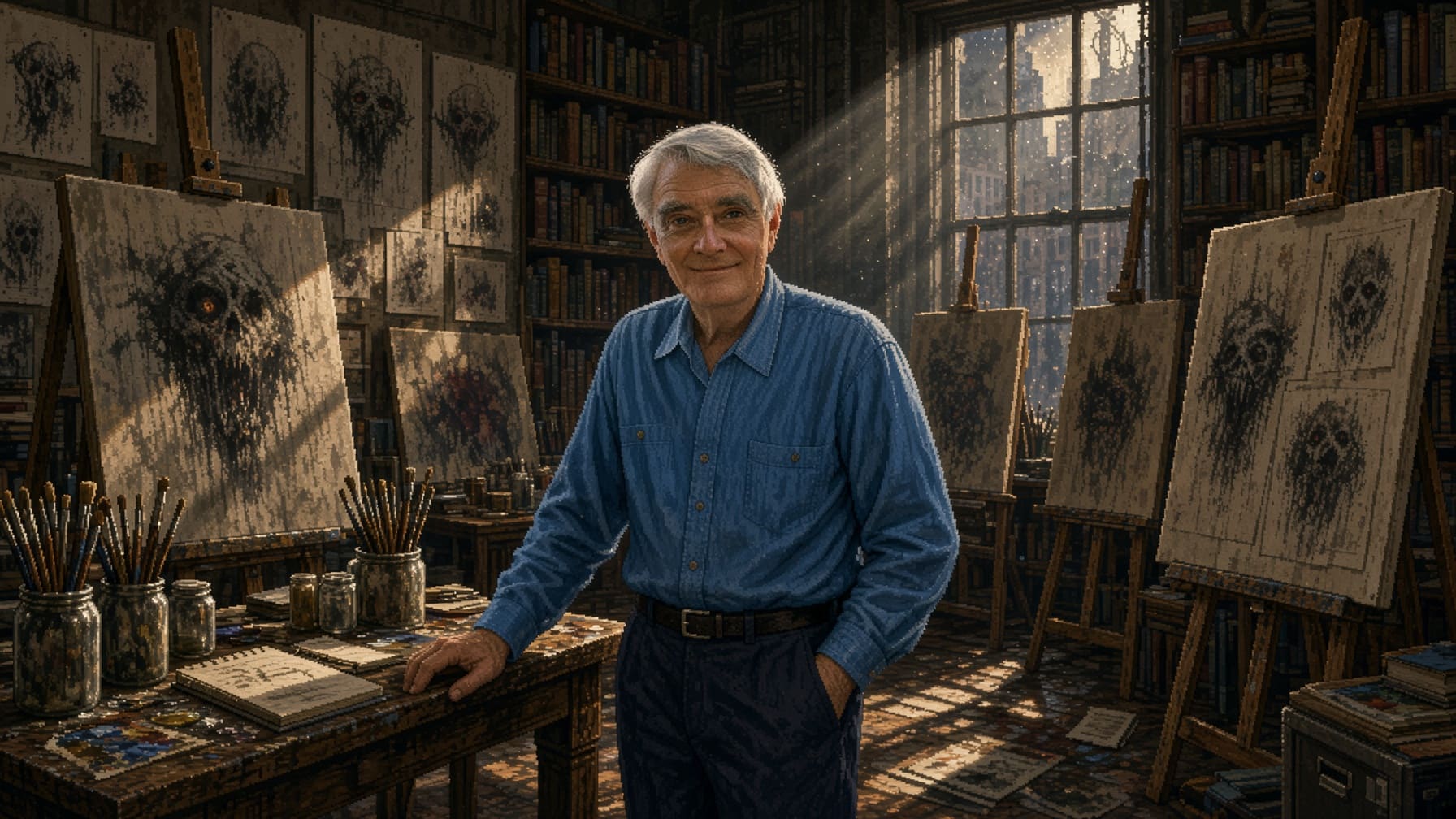
Budd Hopkins was an American abstract expressionist painter who exhibited at the Whitney Museum and Museum of Modern Art after graduating from Oberlin College in 1953 and settling in New York. He later founded the Intruders Foundation in 1989 to support alleged abduction experiencers.
Hopkins claimed that hypnosis sessions with hundreds of ordinary people revealed consistent patterns of alien abductions including medical examinations, reproductive procedures, and presentations of hybrid infants, which he detailed in books published in 1981 and 1987.
- Born June 15, 1931, in Wheeling, West Virginia; graduated Oberlin College 1953 with B.A. in art history.
- Witnessed daylight UFO over Truro, Massachusetts, in 1964; began investigations after 1975 North Hudson Park landing case reported in Village Voice.
- Published Missing Time in 1981 and Intruders in 1987, the latter a New York Times bestseller for four weeks.
- Founded Intruders Foundation in Manhattan in 1989 to research and support abduction claimants.
- Died August 21, 2011, in New York City from cancer complications at age 80.
- United StatesBorn and lifelong resident
- Oberlin CollegeB.A. Art History, 1953
- Intruders FoundationFounder and president, 1989–2011
- Guggenheim FellowshipPainting, 1976
- Whitney Museum of American ArtExhibited and collected
Background
Elliot Budd Hopkins was born on June 15, 1931, in Wheeling, West Virginia. He contracted polio at age two and spent months recovering by sculpting model ships from clay. He graduated from Linsly Military Institute in 1949 and earned a bachelor's degree in art history from Oberlin College in 1953. Hopkins then moved to New York City where he entered the Abstract Expressionist scene alongside artists including Mark Rothko, Robert Motherwell, and Franz Kline.
After college Hopkins attended Columbia University briefly and began exhibiting paintings and sculptures. His first solo show occurred in New York in 1956. He received commissions including a large public work for the West Virginia State Capitol complex in the 1960s. His geometric abstract works entered permanent collections at the Whitney Museum, Museum of Modern Art, Guggenheim Museum, and Hirshhorn Museum.
A 1964 daytime sighting of a dark elliptical object hovering over Truro, Massachusetts, for several minutes shifted Hopkins toward UFO research. He joined the National Investigations Committee on Aerial Phenomena and read widely on the topic. In 1975 he investigated a reported UFO landing and occupant sighting in North Hudson Park, New Jersey, and published the account in the Village Voice the following year.
Hopkins began focusing on abduction reports after receiving consistent accounts from unrelated witnesses. He used hypnotic regression with psychologists to recover memories of missing time episodes. His 1981 book Missing Time analyzed seven cases that featured shared elements such as paralysis, physical examinations, and reproductive interventions aboard craft.
The 1987 book Intruders centered on the case of a woman identified as Kathie Davis from Copley Woods, Indiana. It described repeated abductions involving sperm extraction, gynecological procedures, and presentations of hybrid infants to abductees. The book spent four weeks on the New York Times bestseller list and later inspired a 1992 CBS television miniseries.
In 1989 Hopkins established the Intruders Foundation in Manhattan as a nonprofit to investigate cases, provide support to experiencers, and educate the public. He lectured widely, appeared on television programs, and collaborated with other researchers including psychiatrist John E. Mack. His later books included Witnessed in 1996 and the 2009 memoir Art, Life and UFOs.
Hopkins maintained that the consistency of reports across hundreds of cases from diverse individuals pointed to a real phenomenon rather than fantasy or suggestion. Critics accused him of leading witnesses under hypnosis and of promoting unsubstantiated claims. He compared some skeptics to Holocaust deniers, drawing further controversy.
Hopkins continued painting and research until his death. He was married three times and had one daughter, Grace Hopkins-Lisle. His artwork received a Guggenheim Fellowship in 1976 and a National Endowment for the Arts fellowship. He was elected to the National Academy of Design in 1993 and became a full Academician in 1994.
Legacy
Budd Hopkins died on August 21, 2011, in New York City at age 80 from complications of cancer. His books Missing Time and Intruders established core patterns in abduction research that continue to be referenced in UAP literature.
The Intruders Foundation became inactive after his death. His collected papers and artwork remain available through estate archives, and the phrase missing time has entered common usage in discussions of reported encounters.
Last updated 25 October 2026