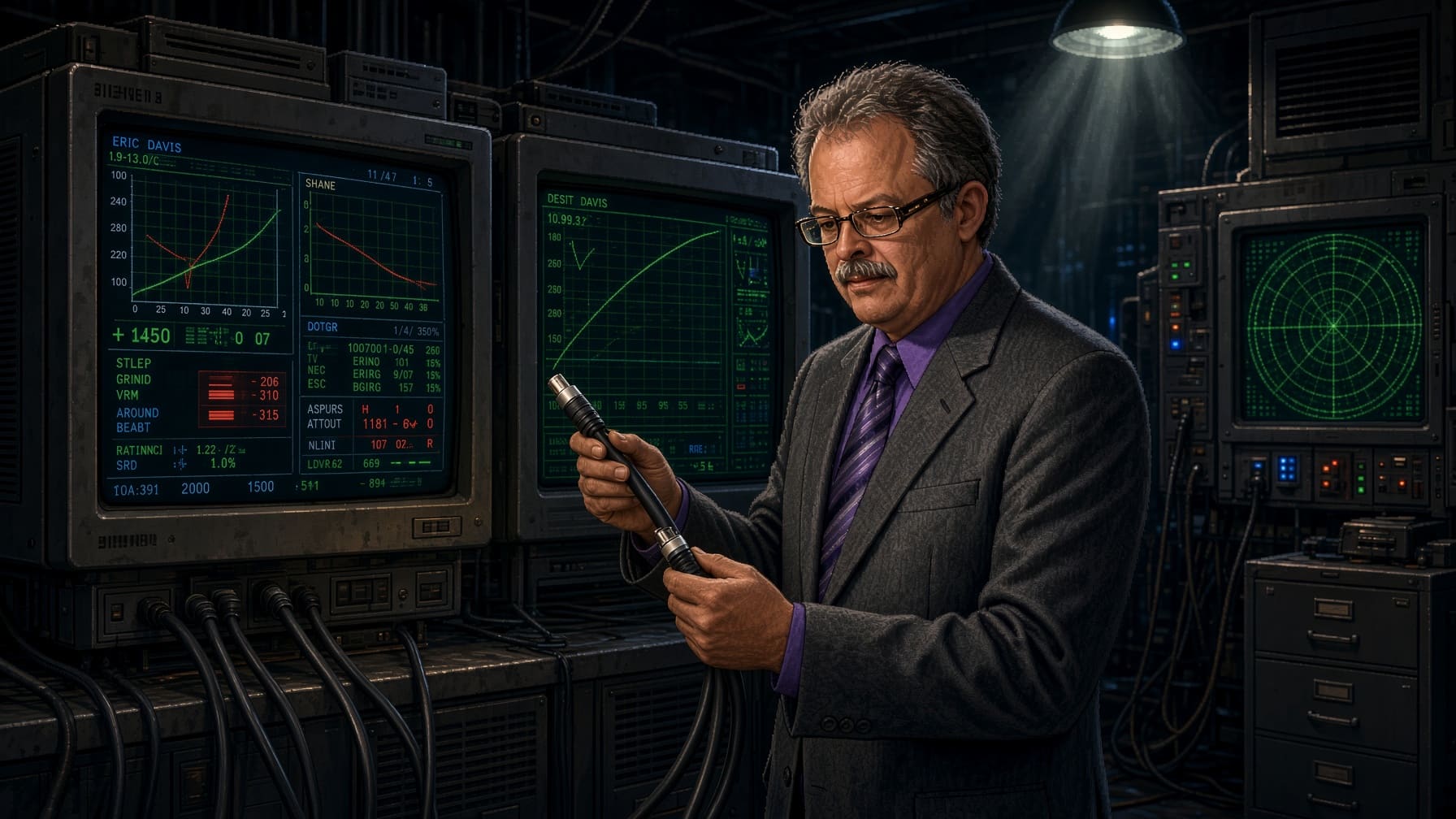
Eric W. Davis is a U.S. astrophysicist with a Ph.D. from the University of Arizona awarded in 1991. He held senior research roles at the National Institute for Discovery Science from 1996 to 2002 and at EarthTech International and the Institute for Advanced Studies at Austin from 2004 to 2019.
Davis consulted on the Defense Intelligence Agency's AAWSAP program and related DoD efforts on advanced aerospace threats and UAP. He has described classified briefings on recovered non-human craft and materials in public interviews since 2019.
- Ph.D. astrophysics, University of Arizona, 1991.
- Senior Project Engineer, The Aerospace Corporation, 2019–2024, supporting NASA and Air Force Research Laboratory projects on space nuclear propulsion.
- Authored 2002 notes of meeting with Adm. Thomas Wilson on a denied-access program involving recovered aerospace technology; notes entered into congressional record in 2022.
- Stated in 2019 interviews that the Pentagon possesses recovered non-human vehicles.
- Claimed in 2026 interviews to have viewed classified records and photographs of bodies from multiple non-human species.
- United States
- National Institute for Discovery ScienceDirector of aerospace physics 1996–2002
- EarthTech InternationalChief science officer 2004–2019
- The Aerospace CorporationSenior project engineer 2019–2024
- Defense Intelligence AgencyAAWSAP consultant
- Air Force Research LaboratoryNuclear propulsion projects support
Background
Eric W. Davis earned an associate degree from Phoenix College in 1981 and a B.Sc. in physics and mathematics in 1983. He completed a Ph.D. in astrophysics at the University of Arizona in 1991. His early career focused on theoretical studies in advanced propulsion and space mission analysis.
From 1996 to 2002 Davis served as director of aerospace physics and astrophysics at the National Institute for Discovery Science. In that role he contributed to investigations at Skinwalker Ranch and research into exotic propulsion concepts under Robert Bigelow.
Davis joined EarthTech International and the Institute for Advanced Studies at Austin in 2004 as chief science officer and senior research physicist. He remained there until 2019, overseeing projects on breakthrough energy and propulsion while providing technical support to government programs.
During his time at EarthTech, Davis participated in the Advanced Aerospace Weapon System Applications Program for the Defense Intelligence Agency and the Advanced Aerospace Threat Identification Program. He also supported the UAP Task Force under the Office of Naval Intelligence.
In October 2002 Davis took handwritten notes during a meeting with retired Vice Adm. Thomas Wilson. The notes describe Wilson's account of being denied access to a special-access program involving recovered non-human craft and technology held by a defense contractor.
From 2019 to 2024 Davis worked as senior project engineer at The Aerospace Corporation in Huntsville, Alabama. He supported NASA, Air Force Research Laboratory, and Office of the Secretary of Defense efforts on space nuclear propulsion systems and compact nuclear power.
Davis has given interviews since 2019 describing classified information on recovered craft and materials. His 2002 notes were submitted to Congress and entered into the record during a May 2022 House Intelligence Committee hearing on UAP.
In 2026 Davis stated publicly that he had reviewed classified photographs and records showing bodies from at least four non-human species recovered from UAP incidents. He identified the species in media appearances as Grays, Nordics, Insectoids, and Reptilians.
Davis has briefed congressional staff and committees in secure facilities on topics including crash-retrieval programs and reverse-engineering efforts. He has urged waivers of nondisclosure agreements to allow broader discussion of UAP evidence.
Where They Are Now
As of October 2026 Eric W. Davis continues as an aerospace-defense industry and U.S. government consultant. He remains active in public discussions of UAP programs and has requested presidential action to protect whistleblowers by waiving certain nondisclosure agreements.
Last updated 25 October 2026