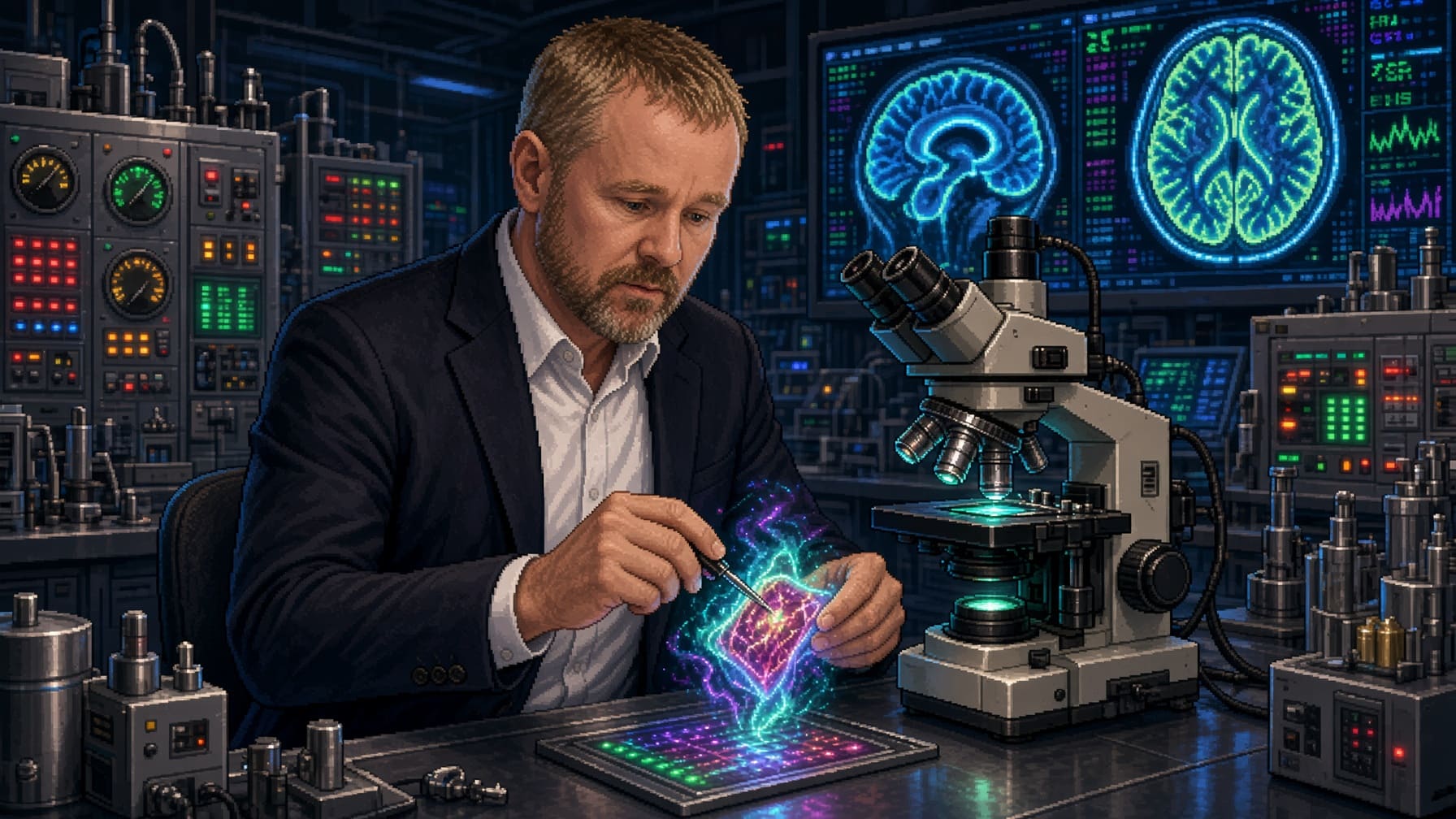
Garry Nolan is the Rachford and Carlota A. Harris Professor in the Department of Pathology at Stanford University School of Medicine. He earned a BS in biology from Cornell University in 1983 and a PhD in genetics from Stanford in 1989, followed by postdoctoral work at MIT with David Baltimore.
Nolan has analyzed alleged UAP physical materials and medical scans from people reporting close encounters. He co-founded the Sol Foundation in 2023 and joined the UAP Science Advisory Council in 2026.
- Joined Stanford faculty in 1993; named Rachford and Carlota A. Harris Professor in 2011.
- Published over 350 research articles and holds 50 US patents; founded multiple biotech companies.
- Co-authored 2022 peer-reviewed paper examining metal from the 1977 Council Bluffs incident.
- In 2023 SALT conference stated 100 percent probability extraterrestrials have visited and remain on Earth.
- Appointed to UAP Science Advisory Council in June 2026.
- United StatesBritish-American citizen since childhood
- Stanford UniversityRachford and Carlota A. Harris Professor since 2011
- Stanford University School of MedicineFaculty member since 1993
- Sol FoundationCo-founder and Executive Director of the Board since 2023
- Department of DefenseTeal Innovator Award recipient 2012
- UAP Science Advisory CouncilMember appointed June 2026
Background
Garry Philip James Nolan was born in 1961 in the United Kingdom. His family emigrated to the United States in 1963 and he grew up in Windsor, Connecticut. He attended Cornell University from 1979 to 1983, receiving a BS in biology with a specialization in genetics.
Nolan earned his PhD in genetics from Stanford University in 1989 under Leonard Herzenberg. He conducted postdoctoral research from 1990 to 1993 with Nobel laureate David Baltimore at MIT, where he worked on NF-κB and retroviral systems.
In 1993 Nolan joined the Stanford University School of Medicine as an assistant professor in the Department of Microbiology and Immunology. He advanced to associate professor in 1999 and full professor in 2009 before receiving the Rachford and Carlota A. Harris Professorship in Pathology in 2011.
Nolan's laboratory developed technologies including CyTOF mass cytometry and MIBI imaging. He has published more than 350 papers, holds approximately 50 US patents, and founded or co-founded biotech companies such as Rigel, Nodality, BINA Technologies, Ionpath, and Akoya Biosciences.
Awards include the Department of Defense Teal Innovator Award in 2012 for ovarian cancer research and the 2024 Stanford University Lifetime Achievement Award. He directed the Stanford NHLBI Proteomics Center from 2010 to 2015.
Around 2012–2020 Nolan was contacted by US intelligence and defense personnel to examine MRI scans and tissue samples from individuals reporting UAP encounters. He identified unusual brain features and injuries in some cases that he attributed to possible directed energy or unknown field effects.
In 2021 and 2022 Nolan discussed his analysis of alleged UAP materials, including samples with anomalous isotope ratios. He co-authored a January 2022 paper in Progress in Aerospace Sciences on metal deposited during the 1977 Council Bluffs, Iowa incident.
Nolan co-founded the Sol Foundation in August 2023 with Peter Skafish to advance rigorous UAP research. In May 2023 at the SALT iConnections conference he stated a 100 percent probability that extraterrestrials have visited Earth and continue to do so.
In June 2026 Nolan was appointed to the newly created UAP Science Advisory Council. He has appeared in interviews and media discussing government interest in UAP artifacts and biological effects while continuing his primary work in immunology and cancer research.
Where They Are Now
As of October 2026, Nolan remains the Rachford and Carlota A. Harris Professor in the Department of Pathology at Stanford University School of Medicine. He serves as Executive Director of the Board of the Sol Foundation and as a member of the UAP Science Advisory Council.
He continues research in single-cell analysis, cancer immunology, and systems biology while participating in UAP-related scientific discussions and advisory work.
Last updated 25 October 2026