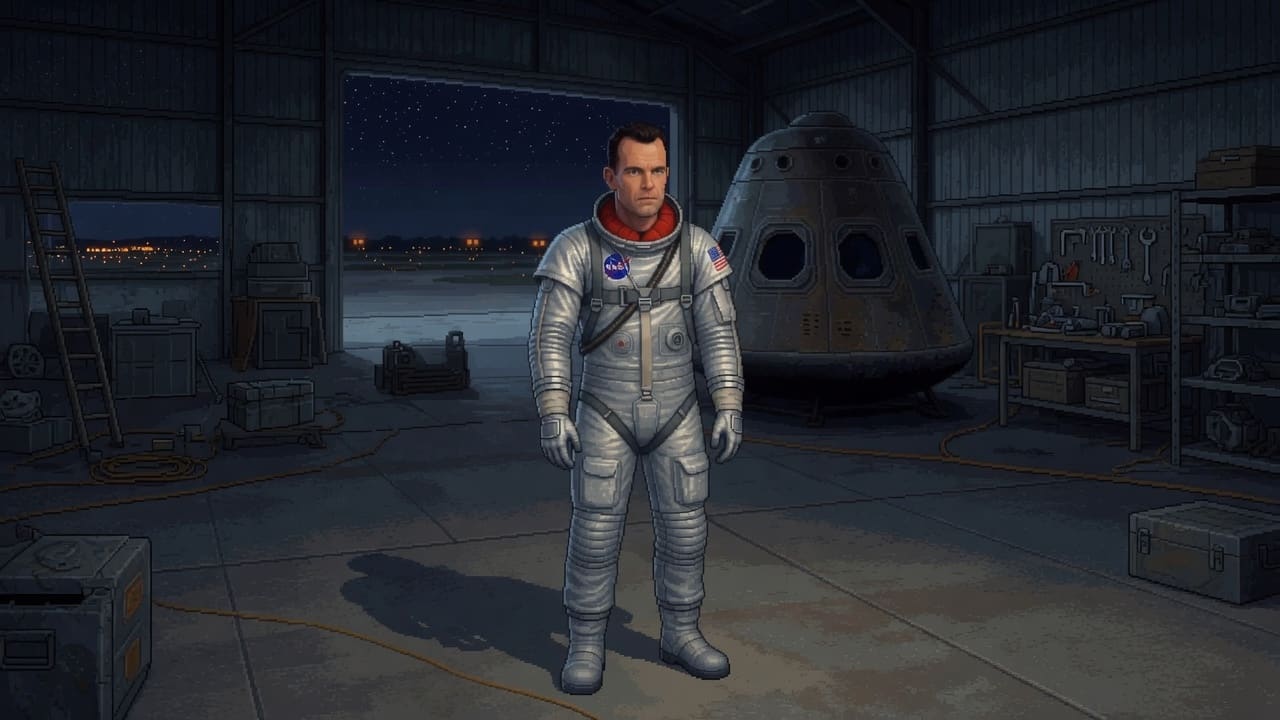
Leroy Gordon Cooper Jr. was a U.S. Air Force test pilot selected in 1959 as one of NASA's original seven Mercury astronauts. He flew the final Mercury mission solo and later commanded a Gemini flight before retiring as a colonel in 1970.
Cooper reported multiple UFO encounters from his military flying days and publicly claimed the U.S. government withheld evidence of extraterrestrial craft visiting Earth, including statements to the United Nations and in his 2000 autobiography.
- Selected as Mercury astronaut in April 1959; flew Mercury-Atlas 9 (Faith 7) May 15–16, 1963, for 34 hours 20 minutes.
- Command pilot of Gemini 5 with Pete Conrad, August 21–29, 1965, setting an eight-day endurance record.
- Reported chasing saucer-shaped UFOs over West Germany in 1951 while assigned to the 86th Fighter Bomber Group.
- In 1957 at Edwards AFB directed Cinetheodolite filming of a UFO that landed and took off; film disappeared to higher authority.
- Addressed a UN panel in 1978 and repeated claims of government cover-up in the 2000 book Leap of Faith until his death.
- United StatesBorn and served
- U.S. Air ForceColonel, 1949–1970
- NASAMercury and Gemini astronaut, 1959–1970
- Project MercuryAstronaut, flew Faith 7
- Edwards Air Force BaseTest pilot 1957–1959
- Colonel, USAFRetired 1970
- NASA Distinguished Service MedalAwarded 1963
Background
Leroy Gordon Cooper Jr. was born March 6, 1927, in Shawnee, Oklahoma. His father, an Army Air Corps officer, introduced him to flying at a young age. Cooper attended schools in Oklahoma and Kentucky, then studied at the University of Hawaii before receiving an Army commission. He transferred to the Air Force and entered active duty in 1949.
Cooper flew F-84 and F-86 fighters with the 86th Fighter Bomber Group in West Germany from 1950 to 1954. During this period he reported sighting and attempting to intercept groups of metallic saucer-shaped objects that outmaneuvered his squadron's jets. He returned to the United States in 1954 and earned a Bachelor of Science in aeronautical engineering from the Air Force Institute of Technology in 1956.
From 1956 to 1957 Cooper completed experimental test pilot training at Edwards Air Force Base, California. In May 1957 he supervised a Cinetheodolite camera crew that filmed an unidentified object landing on a dry lake bed. The film reportedly showed close-up details before the object departed; it was forwarded to the Pentagon and never returned to the base.
NASA selected Cooper in April 1959 as the youngest of the Mercury Seven. He served as backup pilot for Sigma 7 in 1962. On May 15–16, 1963, he piloted Faith 7 on the final Mercury mission, completing 22 orbits in 34 hours 20 minutes. Electrical failures forced him to perform a manual reentry and landing four miles from the recovery ship.
Cooper flew again as command pilot of Gemini 5 with Charles Conrad from August 21 to 29, 1965. The eight-day mission set a new U.S. space endurance record of 190 hours 56 minutes and 3.3 million miles. He later served as backup command pilot for Gemini 12 and backup commander for Apollo 10 before retiring from NASA and the Air Force on July 31, 1970, at the rank of colonel.
After retirement Cooper worked in private aviation and aerospace businesses, including roles at Disney and several engineering firms. He logged over 7,000 flight hours, more than 4,000 in jets. In later interviews and his 2000 autobiography Leap of Faith he recounted his 1951 Germany sightings and the 1957 Edwards film incident while asserting that authorities suppressed UFO data.
Cooper testified before a United Nations panel in 1978, urging coordinated international scientific study of UFO encounters. He maintained that extraterrestrial vehicles and crews were visiting Earth from more advanced planets and that government secrecy prevented open discussion. These statements drew both public attention and skepticism from some former colleagues.
Cooper received the NASA Distinguished Service Medal, Air Force Legion of Merit, and Distinguished Flying Cross with oak leaf cluster. He died of natural causes at his home in Ventura, California, on October 4, 2004, at age 77. His UFO claims remain part of public discussion of astronaut testimony on the topic.
Legacy
Gordon Cooper died October 4, 2004, at age 77 in Ventura, California. His two spaceflights helped demonstrate human endurance and manual control capabilities needed for later lunar missions.
Cooper's public statements on UFO sightings and alleged government cover-ups, including UN testimony and his 2000 autobiography, continue to be cited in discussions of early astronaut experiences with unidentified aerial phenomena.
Last updated 25 October 2026