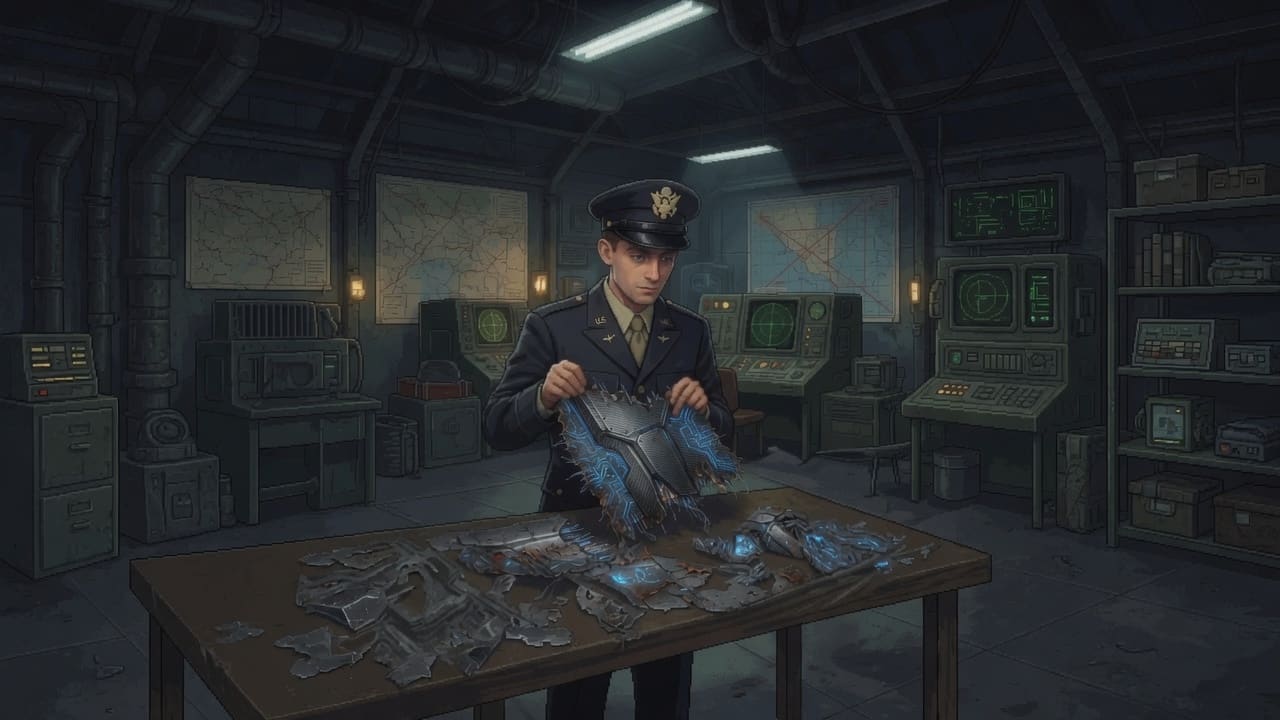
Jesse Antoine Marcel Sr. served as a major in the U.S. Army Air Forces and later U.S. Air Force. He held intelligence officer roles in the Pacific theater during World War II and with the 509th at Roswell Army Air Field in 1947.
In 1978 he publicly stated that debris he recovered near Roswell in July 1947 was extraterrestrial, featuring lightweight metal that resumed shape after crumpling and markings resembling hieroglyphics. The claim revived interest in the incident.
- Commissioned second lieutenant in 1942; promoted to major in May 1945.
- Served as group intelligence officer in the Southwest Pacific with the 5th Bomber Command and received the Bronze Star and two Air Medals.
- Participated in Operation Crossroads atomic tests at Bikini Atoll in 1946 while attached to the 509th Composite Group.
- Recovered and examined debris at the Foster Ranch site on 7 July 1947 and transported samples to Fort Worth Army Air Field.
- Stated in 1978 interviews that the material was not from any known aircraft or balloon.
- United States
- U.S. Army Air ForcesCommissioned 1942
- U.S. Air ForceMajor, served to 1958
- 509th Composite GroupIntelligence officer 1946–1947
- Bronze Star MedalAwarded for WWII service
- Air MedalTwo awarded for combat flight time
Background
Jesse Antoine Marcel Sr. was born on 27 May 1907 in Bayou Blue, Louisiana, the youngest of seven children. He graduated from Terrebonne High School and worked as a draftsman and cartographer for the Louisiana Highway Department, Army Corps of Engineers, and Shell Oil Company before military service.
Marcel enlisted in the Louisiana National Guard in 1924 and later the Texas National Guard. In March 1942 he received a commission as a second lieutenant in the U.S. Army Air Forces and attended intelligence school in Harrisburg, Pennsylvania.
In October 1943 he deployed to the Southwest Pacific as a squadron and later group intelligence officer with the 5th Bomber Command. He flew combat missions, accumulated hundreds of flight hours, and earned the Bronze Star and two Air Medals before promotion to major in May 1945.
After the war Marcel was assigned to the 509th Composite Group. In mid-1946 he supported Operation Crossroads, the atomic bomb tests at Bikini Atoll, receiving commendations for his performance.
In January 1946 he joined the 509th at Roswell Army Air Field as intelligence officer. On 7 July 1947 base commander Colonel William Blanchard ordered him and Counter Intelligence Corps agent Sheridan Cavitt to the Foster Ranch to investigate reported wreckage.
Marcel collected lightweight metal fragments, foil-like material, and I-beam pieces with purple geometric markings. He returned samples to the base and was then directed to fly material to Fort Worth, where General Roger Ramey publicly identified it as a weather balloon.
Marcel remained with the 509th until August 1948, then transferred to Strategic Air Command at Andrews Air Force Base and later Offutt Air Force Base. He requested a hardship discharge in 1950 to care for family and transferred to the Air Force Reserves.
He received his final discharge in 1958 while retaining the rank of major on active duty and lieutenant colonel in the reserves. In later years he worked as a self-employed television repairman in Houma, Louisiana.
The 1947 incident received little attention until 1978 when ufologist Stanton Friedman interviewed the retired Marcel, who described the debris as unlike any terrestrial material. Additional interviews followed, including one with National Enquirer reporter Bob Pratt in December 1979.
Marcel maintained until his death that the material could not be identified as aircraft, balloon, or missile parts and featured unusual properties and markings. He died of heart failure on 23 June 1986 in Houma at age 79.
Legacy
Jesse Marcel died on 23 June 1986 in Houma, Louisiana. His 1978 statements formed the foundation for renewed public and research interest in the 1947 Roswell incident.
His account of recovering and examining the debris has been cited in numerous books, documentaries, and congressional hearings on UAP topics.
Last updated 25 October 2026