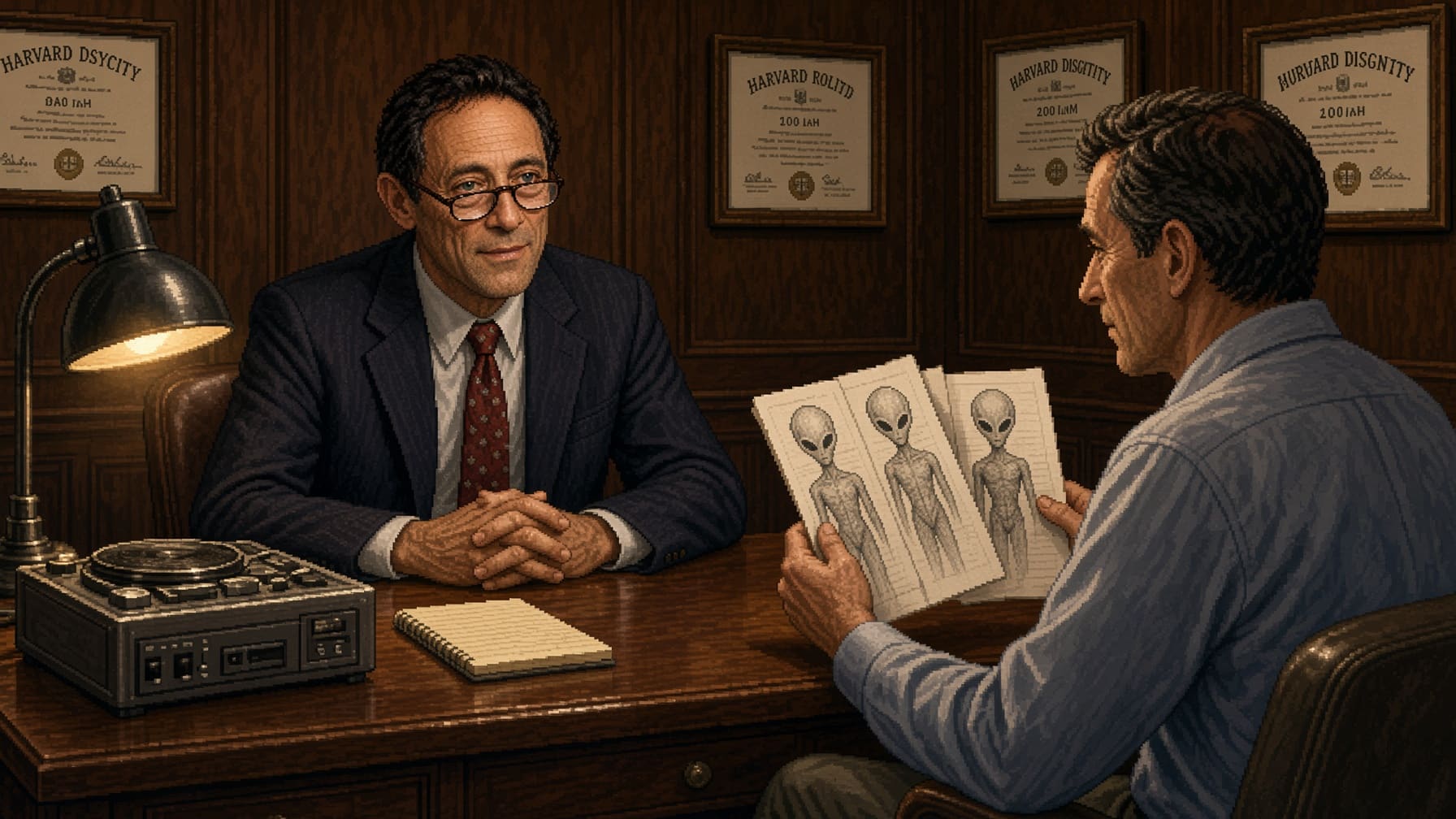
John Edward Mack was an American psychiatrist who served as professor of psychiatry at Harvard Medical School from 1972 and chairman of the department from 1977 until his death. He also founded the psychiatry department at Cambridge Hospital and won the 1977 Pulitzer Prize for Biography.
Mack began studying people reporting alien abductions in 1990 and published Abduction in 1994. He concluded the experiences were real interactions with non-human intelligence after ruling out hoax, psychosis, and false memory in extensive clinical sessions.
- Professor of Psychiatry at Harvard Medical School 1972–2004 and department chairman 1977–2004.
- Pulitzer Prize winner 1977 for A Prince of Our Disorder.
- Began abduction research 1990; published Abduction 1994.
- Harvard Medical School review 1994–1995 upheld academic freedom.
- Died September 27 2004 after being struck by a vehicle in London.
- United StatesBorn and lifelong citizen
- Harvard UniversityProfessor of Psychiatry 1972–2004
- U.S. Air ForceCaptain 1959–1961
- Harvard Medical SchoolChairman Department of Psychiatry 1977–2004
- Pulitzer PrizeBiography 1977
Background
John Edward Mack was born October 4 1929 in New York City. He graduated from Oberlin College with a BA in 1951 and earned his MD cum laude from Harvard Medical School in 1955. He completed internship at Massachusetts General Hospital and psychiatric training at Massachusetts Mental Health Center.
Mack served in the U.S. Air Force from 1959 to 1961 as a captain and psychiatrist in Japan. He returned to complete psychoanalytic training at the Boston Psychoanalytic Society and Institute and received certification in child and adult psychoanalysis.
In 1964 Mack joined the Harvard Medical School faculty. He became a full professor in 1972. He helped establish and led the psychiatry department at Cambridge Hospital which became a Harvard teaching affiliate.
Mack published Nightmares and Human Conflict in 1970. His 1976 biography A Prince of Our Disorder on T. E. Lawrence won the Pulitzer Prize for Biography in 1977. He explored themes of worldviews and human conflict throughout his early career.
In 1983 Mack founded the Center for Psychology and Social Change in Cambridge Massachusetts. The center later supported his work on extraordinary experiences. He maintained clinical practice and academic roles at Harvard through the 1980s.
Mack first encountered reports of alien abductions around 1990. He began intensive evaluations using clinical interviews and hypnosis. By 1994 he had worked with more than 200 individuals and rejected standard psychiatric explanations for most cases.
Mack published Abduction: Human Encounters with Aliens in 1994. The book presented thirteen detailed cases and argued the experiences involved real encounters with non-human intelligence from another dimension or planet. He also traveled to Zimbabwe in November 1994 to interview children at the Ariel School.
Harvard Medical School appointed a review committee in May 1994 following media coverage of the book. The fifteen-month inquiry examined Mack's methods and patient care. In 1995 the dean reaffirmed his academic freedom while urging adherence to clinical standards.
Mack published Passport to the Cosmos in 1999 expanding on the spiritual and cultural implications of the encounters. He continued lectures and interviews while maintaining his Harvard position until 2004. He also addressed nuclear threats and environmental issues earlier in his career.
Legacy
John Mack died on September 27 2004 at age 74 after being struck by a drunk driver while walking in London. He was attending a T. E. Lawrence conference.
His books Abduction and Passport to the Cosmos remain key references in discussions of abduction claims. The John E. Mack Institute continues to archive his research and related materials.
Last updated 25 October 2026