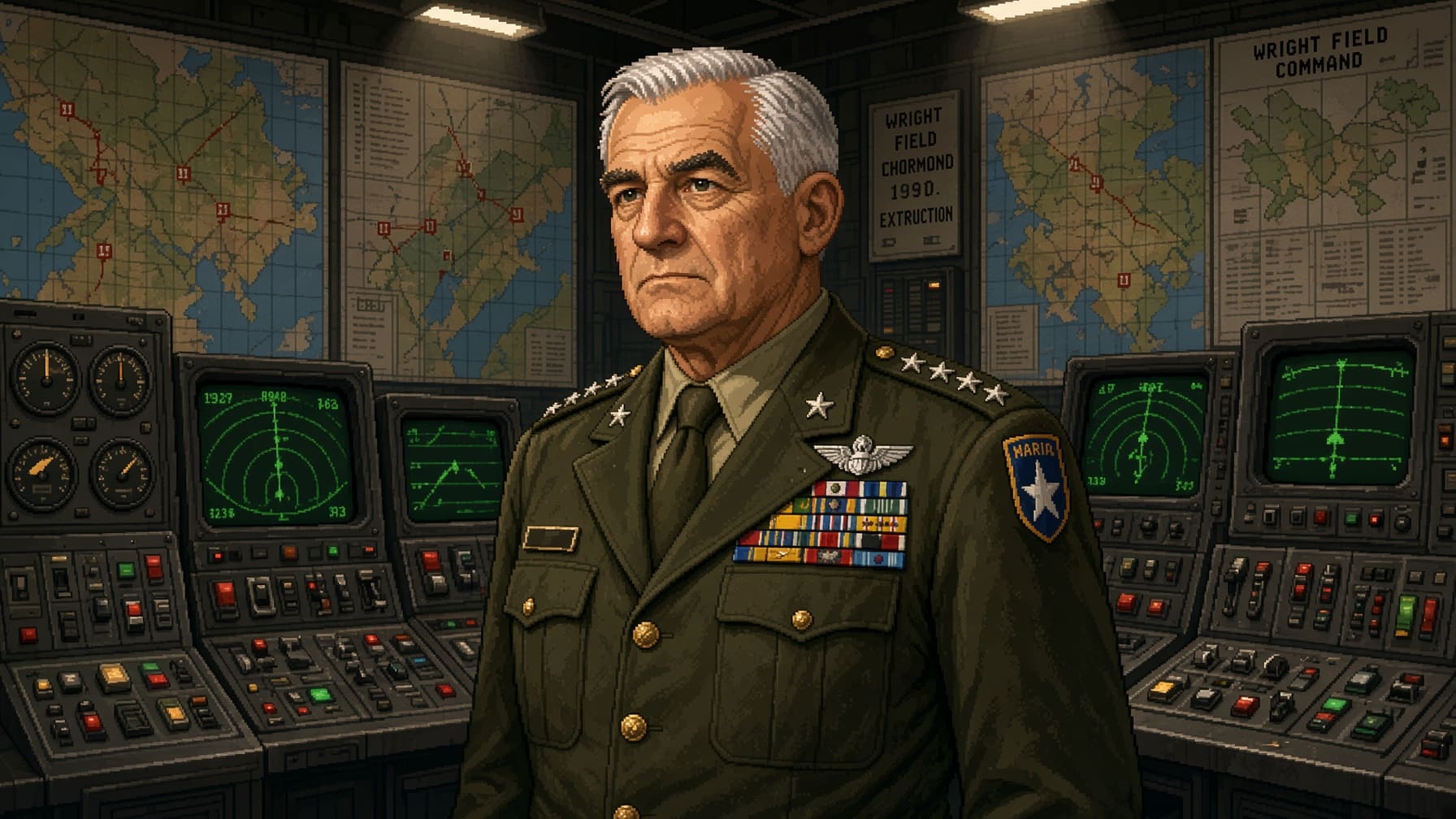
Nathan F. Twining was a U.S. Air Force general who rose from private to four-star rank over a 45-year career. He commanded air forces in the South Pacific, Mediterranean, and Pacific theaters during World War II and later served as Chief of Staff of the Air Force and Chairman of the Joint Chiefs of Staff.
In September 1947, while commanding Air Materiel Command at Wright Field, Twining signed a memo assessing flying disc reports. The document treated the sightings as a technical intelligence matter and recommended a detailed classified study project.
- Commanding General, Air Materiel Command, Wright Field, 1947
- Signed September 23, 1947 memo concluding flying discs were real metallic objects under intelligent control
- Chief of Staff, United States Air Force, 1953–1957
- Chairman, Joint Chiefs of Staff, 1957–1960; first Air Force officer in the role
- Retired September 1960
- United States
- United States Air ForceChief of Staff 1953–1957
- Joint Chiefs of StaffChairman 1957–1960
- Air Materiel CommandCommanding General 1947
- Thirteenth Air ForceCommander 1943
- Twentieth Air ForceCommander 1945
- Distinguished Service MedalAwarded for WWII service
Background
Nathan Farragut Twining was born October 11, 1897, in Monroe, Wisconsin. His family moved to Oregon where he joined the Oregon National Guard in 1916 and served on the Mexican border. He received an appointment to the U.S. Military Academy at West Point and graduated in 1918 after an accelerated wartime course.
Twining completed flight training in 1924 and held staff and engineering positions in the Army Air Corps during the interwar years. He graduated from the Command and General Staff School in 1937 and rose through the ranks as the United States prepared for World War II.
In 1942 Twining deployed to the South Pacific as chief of staff of Allied air forces. In January 1943 he took command of the Thirteenth Air Force and later directed all U.S. and Allied air operations in the Solomon Islands area. He flew combat missions during the Guadalcanal and Bougainville campaigns.
In late 1943 Twining moved to the Mediterranean theater and assumed command of the Fifteenth Air Force in Italy. He directed strategic bombing against German targets and the Balkans before returning to the Pacific in 1945 to lead the Twentieth Air Force operating B-29s against Japan.
After the war Twining served in senior Air Force positions. In 1947 he became Commanding General of Air Materiel Command at Wright Field, Ohio. On September 23 of that year he signed a memo to Brigadier General George Schulgen that evaluated the wave of flying disc reports.
The memo stated the phenomenon was real and not fictitious. It described objects that were metallic or light-reflecting, circular or elliptical, often seen in formation, and capable of speeds above 300 knots with extreme rates of climb and evasive maneuvers. It recommended a priority classified study and distribution of data to other agencies.
Twining continued to advance after the memo. He became Vice Chief of Staff of the Air Force in 1950 and Chief of Staff in 1953. In that role he oversaw the transition to an all-jet force with nuclear capability. President Eisenhower appointed him Chairman of the Joint Chiefs of Staff in 1957, the first Air Force officer to hold the position.
Twining retired from active duty in September 1960. He had received multiple U.S. and foreign decorations for his World War II service and postwar leadership. He died March 29, 1982, at Lackland Air Force Base, Texas.
Legacy
Nathan F. Twining died March 29, 1982, at age 84 at Wilford Hall Medical Center, Lackland Air Force Base, Texas. His 1947 memo entered public records through later declassifications and remains a primary early government document treating UFO reports as a technical matter requiring study.
Last updated 25 October 2026